
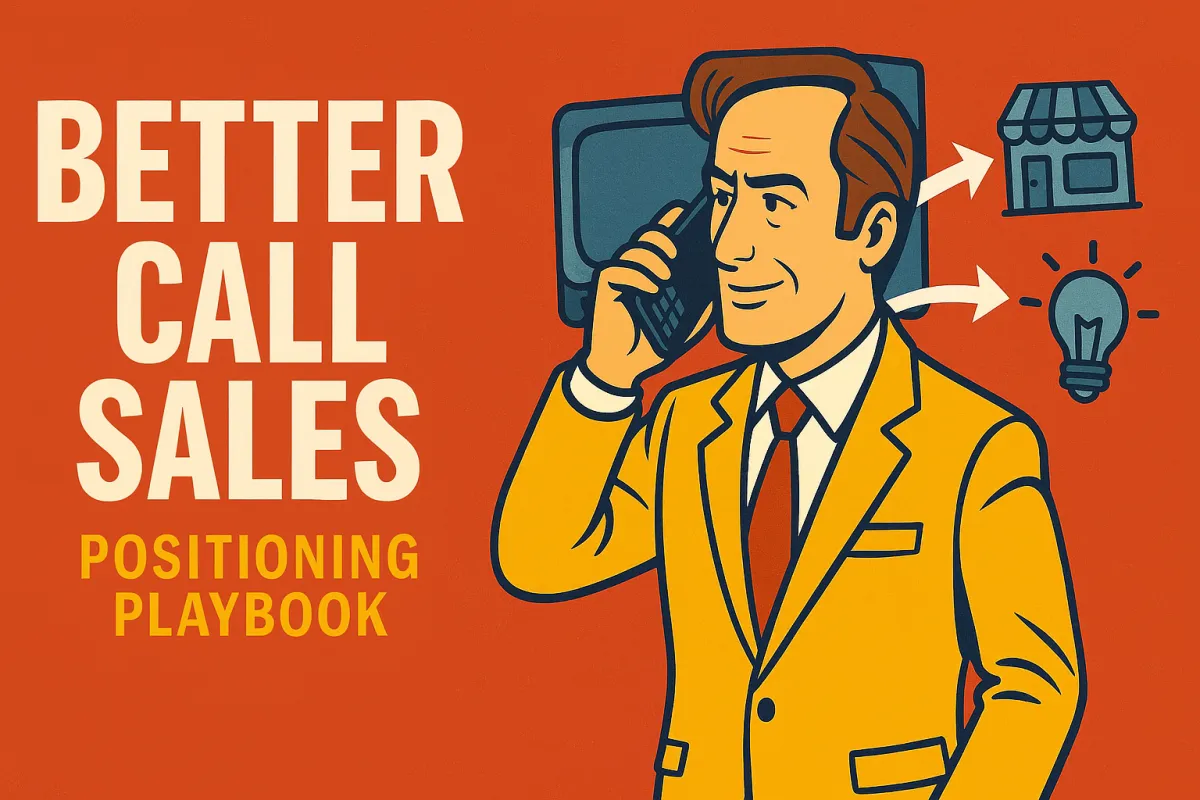
What Better Call Saul Can Teach You About Positioning, Marketing, and Sales (For Service-Based Businesses)
Yes, I’m about to break down a sales masterclass… from a fictional lawyer turned burner phone dealer.
No spoilers here. I'll be talking real strategy hidden in one of the most brilliant shows ever made: Better Call Saul.
And more importantly: how it applies to your world as a service-based business owner — whether you’re a coach, consultant, agency owner, tradesperson, or local pro trying to stand out.
Let’s get into it.
The Setup: Dead Store. No Traffic. No Sales.
Saul (aka Jimmy) loses his license to practice law and ends up working retail at a cell phone store called CC Mobile.
The store is dead.
No walk-ins.
No activity.
No sales.
He calls his boss to ask about getting moved to a busier location.
“Bring a book,” they tell him.
Most people would do exactly that: sit, wait, scroll, complain.
Jimmy doesn’t.
He builds demand from nothing.
And that’s where the marketing lesson starts.
Lesson #1: Create a Customer (Not Just a Sale)
Most business owners look for people who already want the thing they sell:
“Who’s looking for a personal trainer?”
“Who needs a plumber right now?”
“Who’s already searching for a photographer?”
Jimmy flips that.
He looks at the same boring product — a cheap prepaid phone — and reframes it completely: He’s not selling a phone. He’s selling privacy.
He paints the store windows with messages like:
“Is the man listening?”
“Privacy sold here.”
Nobody woke up thinking, “I need a burner phone today.”
But people do walk around worried about:
Their ex
Their boss
The IRS
“Someone” watching
Jimmy doesn’t look for “phone shoppers.”
He creates a new kind of customer by changing the context.
What This Means for Your Business
As a service provider, you might be:
Selling “web design” when your client wants “more bookings”
Selling “coaching sessions” when they want “to stop feeling stuck and burned out”
Selling “landscaping” when they want “neighbors to stop judging the lawn”
You don’t always need a brand-new offer. You might only need a new angle:
Not “3-month coaching program” → “A 90-day plan to stop leaking clients and grow without burning out.”
Not “CRM setup” → “A system that makes sure every lead hears from you at least five times (without you chasing them).”
Not “social media management” → “A done-for-you presence that keeps you top-of-mind when your ideal clients are ready to buy.”
Same service. Different story. New customer.
Lesson #2: Sell the Problem, Not the Product
When a prospect walks into the store, Jimmy doesn’t start talking about:
Battery life
Data plans
Camera quality
He starts with the problem:
“People are listening.”
“They know every detail.”
“You’re living free until they decide to drop the hammer.”
He never says who “they” are.
The customer fills in the blank:
“You mean… the IRS?”
Bingo.
The fear is now self-generated.
When the problem feels real, the phone becomes the obvious solution.
What This Means for Your Business
Most service-based businesses accidentally lead with:
Features (“6 sessions”, “weekly calls”, “unlimited revisions”)
Tools (“we use AI”, “we use HighLevel”, “we use the latest software”)
Process (“we’ll hop on a discovery call, then…”)
Your customer doesn’t care about the machine. They care about:
The tax letter that scared them
The furnace that might die this winter
The constant guilt over unread leads and unanswered messages
Try this:
Instead of “We do bookkeeping for small businesses,” say:
“We make sure you never panic over a tax letter again.”
Instead of “We set up lead automation,” say:
“We stop your leads from slipping through the cracks when you’re busy doing the work.”
Instead of “We build websites,” say:
“We turn your site into a 24/7 salesperson that answers questions and nudges people to book.”
If the problem is crystal clear and visceral, the solution doesn’t need a hard sell.
Lesson #3: Name the Problem, Frame the Solution
In the show, Jimmy coins a phrase for what he’s really selling:
“Information hygiene.”
He’s not selling a burner phone. He’s selling a lifestyle and a story:
Stay clean.
Stay unseen.
Stay untraceable.
He gives specific rules:
Pay cash
Use once
No records
No tracking
Same phone everyone else sells.
Completely different meaning.
He even fakes demand with a staged call:
“Nope, everyone wants these. I can only do six.”
Then he smashes a phone right in front of the customer to show exactly how to use — and destroy — it.
It’s theater, but it works.
What This Means for Your Business
Can you:
Name the problem you solve in a simple phrase?
Turn your service into a framework or method people can latch onto?
Examples:
A marketing consultant might sell “The No-Lead-Left System.”
A fitness coach might sell “The Busy Parent Reset.”
A copywriter might sell “The Client-Ready Pitch Deck.”
Don’t just say “I do X.”
Name the specific outcome or way you do it.
You’re not “just a service provider.”
You’re the creator of a method that keeps your clients safe, sane, or successful.
Lesson #4: Fix the Fit — Looks, Tone, and Vibe Matter
Later, Jimmy tries selling phones out of his car… wearing his lawyer suit.
Wrong move.
The street kids think he’s a narc.
He looks like the system.
They don’t trust him.
So he fixes the fit.
He ditches the suit, grabs a tracksuit, and dresses like the people he’s trying to reach.
Suddenly, the same pitch lands — and he can’t keep phones in stock.
What This Means for Your Business
As a service-based business, your “fit” shows up in:
The words on your website
The tone of your emails
The way you answer the phone
How you show up on calls or in person
If your clients are:
Contractors and trades → And you sound like a corporate consultant, you’ll lose them.
Therapists/coaches → And you sound like a bro marketer, you’ll lose them.
Tech-shy local owners → And you bury them in jargon, you’ll lose them.
Ask yourself:
“If my ideal client saw my site, emails, and socials — would they say:
‘Wow, this person gets me’ or ‘This feels like it’s for someone else’?”
You don’t need to cosplay.
But you do need to show that you understand their world.
Lesson #5: Go Where the Customers Already Are
The original problem?
The store has no traffic.
People aren’t walking in asking for burner phones. They don’t even know they need one.
So Jimmy stops waiting.
He starts selling phones out of his trunk, in the places where his ideal customers:
Hang out
Live
Do business
Traffic problem: solved.
What This Means for Your Business
Your version of “selling from the trunk” might look like:
Posting consistently where your people actually are (not just where you’re comfortable)
Showing up at BNI, local meetups, industry events — with a clear, compelling offer
Running simple ads to warm audiences instead of screaming into the void
Following up with people who already showed interest, instead of chasing strangers
The best offer in the world doesn’t help you if it’s:
Sitting on a quiet website
Buried in a menu
Hidden behind a vague “contact us” form
You can either complain about not having enough leads…
or bring your message to the people who actually need you.
Lesson #6: Speak Their Language
In one scene, Jimmy approaches a biker gang to sell his phones.
He doesn’t say “prepaid mobile device” or “burner phone.”
He says something like:
“Private conversations are few and far between.”
They get it instantly.
Then he points out how small the phones are. How easily they can be hidden. He doesn’t need to spell out why that matters to them.
He understands their world, their risks, their pressure.
So he speaks to it.
What This Means for Your Business
Your clients also have:
Fears they won’t say out loud
Pressures they feel every day
Outcomes they really want but don’t always describe clearly
Instead of saying: “We specialize in CRM implementations,” say:
“We make sure no one who reaches out to your business gets ignored.”
Instead of “I offer leadership coaching,” say:
“We help you stop putting out fires all day and start leading like the owner you meant to be.”
Use their words, not yours.
When the pain is clear and the solution feels obviously connected, you don’t have to push.
People just buy.
Bringing It Home: What This Looks Like in Your Business
You and Jimmy McGill probably don’t have much in common on paper.
But if you:
Run a service-based business
Feel like you’re in a “dead store” some days (quiet inbox, inconsistent leads)
Or feel like you’re getting attention but not converting it into clients
Then these lessons apply directly to you.
You might not need:
A new business model
A brand-new offer
Or some complicated tech stack
You might just need to:
Reframe what you do so it hits a deeper, more relevant problem
Show up where your ideal clients already are
Speak in language they actually use
Make sure your look, tone, and systems match the people you want to attract
If You’re Feeling Stuck, Ask Yourself:
Where am I waiting for traffic instead of going to it?
Am I selling “the thing” or the problem it solves?
Does my brand, tone, and approach look like someone my ideal client would trust?
If I doubled my leads tomorrow, could my follow-up and systems handle it — or would I just drop the ball faster?
Those are the levers you can pull today, before you redo your logo or build some giant new funnel.
Your Move
Take one scene from this post and apply it:
Rewrite one offer on your website to focus on a clearer problem.
Rename one package to reflect the outcome, not the input.
Change one script, one email, or one DM reply so it sounds more like your client and less like generic marketing speak.
Then ask:
“If Saul can turn a dead cell phone shop into a thriving burner phone empire…
what could I do with the service I’m actually great at?”
And if you’ve got another TV series you think secretly doubles as a marketing, positioning, or sales clinic?
Drop it in the comments.


