
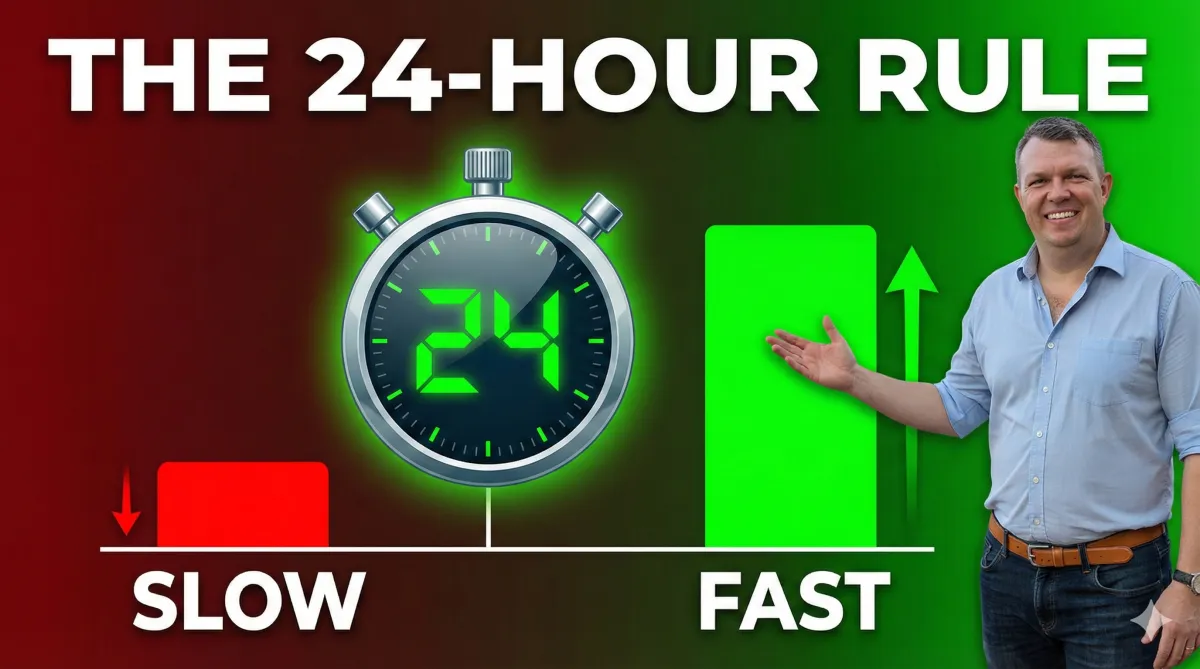
The 24-Hour Rule: How Fast Follow-Up Changes Your Revenue (Without Adding More Hours to Your Week)
The 24-Hour Rule: How Fast Follow-Up Changes Your Revenue (Without Adding More Hours to Your Week)
If you’re running a service business, you’ve had this moment: the day finally slows down, you open your phone, and there they are—missed calls from yesterday, a couple of messages you meant to answer, and a form submission you completely forgot about.
You tell yourself, “I’ll handle all of this tomorrow.”
Then tomorrow looks exactly the same.
That’s not a character flaw. It’s the reality of running a business where everything depends on you.
The owners I work with—coaches, contractors, gyms, agencies, local specialists—are sharp, capable, and motivated. They care about people. They care about relationships. Most of them are in BNI and know how to show up for others. But when it comes to follow-up, they’re stretched across too many conversations, platforms, and responsibilities to keep up.
And that gap between intention and execution is expensive.
Sam’s Week (Or Yours, Or Anyone Running a Busy Service Business)
Let’s anchor this in a familiar picture.
Sam runs a solid service business. Their phone rings enough. Referrals trickle in. Social DMs show interest. There’s no shortage of people raising their hands.
But here’s how the week unfolds:
Monday: Ten calls come in while Sam is out serving clients. A few get returned late that night.
Tuesday: Two of those leads already hired someone else. One ghosted.
Wednesday: A referral emails, “Hey—did you get my message last week?”
Friday: Sam decides that next week will be the week they finally build a follow-up system.
Sam isn’t struggling with leads. Sam is struggling with bandwidth, timing, and structure. And that’s what most service business owners quietly deal with.
Why the 24-Hour Rule Matters
Here’s the simplest version of the truth: responsiveness is a competitive edge.
When someone reaches out, they’re not just interested—they’re in motion. If they don’t hear back while that momentum is fresh, the likelihood of closing them drops fast. Not because you’re less qualified, but because life gets in the way.
They call the next person.
They get distracted.
The urgency fades.
They forget who you were.
The 24-Hour Rule is straightforward: every inquiry gets a response within 24 hours. Same day if possible. It doesn’t need to be a full pitch. It just needs to keep the door open while they still care.
The Revenue Difference Between Fast and Slow Follow-Up
Let’s put real numbers to this.
If you get 100 leads a month and your typical service is worth around $1,000, that’s $100,000 in potential revenue.
With quick, consistent follow-up, maybe you close 20%. That’s $20,000.
If your follow-up is inconsistent, maybe you close 10%. That’s $10,000.
A 24-hour response window is a $10,000/month difference—a six-figure year swing—without changing anything about your marketing.
No additional ad spend.
No new funnels.
No “ultimate” course.
Just faster, simpler, more reliable follow-up.
And for many of my clients—painters, trainers, consultants, HVAC techs—the real numbers are even higher.
“But I’m Already Maxed Out…”
Every owner hits this point. They assume that speeding up follow-up means working longer hours or turning into an aggressive salesperson.
That’s not the point of the 24-Hour Rule.
The point is to design your follow-up so it works on the days when you’re underwater, not just the days when you're feeling organized.
The owners I coach don’t follow up faster because they work more—they follow up faster because we build a system that does the heavy lifting for them.
Let’s break down what that actually looks like.
Step 1: Define What Fast Follow-Up Looks Like for You
You don’t need a complicated playbook. You just need two levels of response:
Immediate acknowledgment
This can be automated. A quick text or email that says, “Got your message—here’s what happens next.”
Not a sales pitch. Just a human touchpoint.
Within 24 hours, a personal follow-up
A simple call or message. Something that gets the conversation moving.
Your goal is not to close them in the first reply.
Your goal is to make sure the conversation doesn’t cool before it starts.
Step 2: Use Simple, Ready-to-Send Messages
One reason owners hesitate to follow up quickly is because they feel like every reply needs custom attention. It doesn’t. A good system removes the thinking.
Here’s a streamlined example you can drop straight into your phone:
After a missed call:
“Hey [[Name]], saw I missed your call. This is [[You]] from [[Business]]. Are you still looking for help with [[problem]]? I have availability [[two time options]]. Want me to hold a spot?”
After a form submission:
“Hey [[Name]], thanks for reaching out about [[service]]. Quick question—what’s the main thing you’re trying to solve right now? Once I have that, I’ll point you to the best next step.”
When you’re late:
“Hey [[Name]], quick apology—I’m just catching up and didn’t want to leave you hanging. Are you still needing help with [[problem]]? If yes, here are two times that work for me.”
Service-business owners appreciate honesty. You don’t need perfect. You need presence.
Step 3: Build a Simple System That Doesn’t Rely on Memory
This is where your dream customers wake up to the reality: they don’t need another course; they need infrastructure.
A basic, reliable follow-up system has three components:
A single place where every lead lives (CRM, spreadsheet, notebook—pick one).
A short window each day dedicated to responding.
A structure that ensures nobody gets forgotten.
That’s it.
Not a 14-step automation labyrinth. Just enough friction removal to stay consistent.
This is the part that turns overwhelmed business owners into confident ones—because they no longer carry their entire pipeline in their head.
Step 4: Decide What “Enough Follow-Up” Means
Most owners stop too early because they’re worried about being annoying. But most leads who ghost aren’t rejecting you—they’re juggling their own lives.
Pick a simple rule: three to five touches before you close the loop.
Spacing it out over a week or two keeps you top of mind without being pushy.
A final message like this works well:
“Hey [[Name]], just closing the loop. If now’s not the right time, no problem—I can re-open your file anytime. Wishing you the best with [[goal]].”
You’d be surprised how many “lost” leads come back when you send that.
Why This Hits So Hard for Owners
Follow-up isn’t just a system challenge—it’s emotional. It sits in the same mental category as finances, taxes, overdue tasks: heavy but important.
And because you built your business on relationships, dropped balls feel personal.
But you don’t need to change your personality or work ethic. You just need a structure that backs you up so your strengths—your care, your expertise, your reliability—actually reach people before they drift away.
This is what I tell the owners I work with:
You’re not doing less. You’re doing it at the right time.
Bringing It All Together
Here’s what the 24-Hour Rule looks like in real life:
A quick acknowledgment message goes out right away
You follow up personally the next day
Every conversation lives in one place
You check that place daily
You follow up three to five times unless someone tells you otherwise
Leads stop falling through the cracks
Your revenue rises before your marketing spend does
This is the grown-up version of business growth—consistent, predictable, and respectful of the leads you’ve already earned.
If you master this one habit, your revenue changes without adding hours to your day.
And if you’re reading this thinking, “I get it, I just know I won’t set all this up alone,” you’re exactly the kind of owner I built my programs for. You don’t need more knowledge. You need a guide and a system that actually gets implemented.
But even without anything fancy, you can start the 24-Hour Rule today.
Your future clients are already waiting—they just need to hear from you a little faster.


